Newshub-Detail
BERN 131: What sustainable property must deliver today
Around a third of global energy- and process-related CO₂ emissions are attributable to the building and property sector. However, a property’s carbon footprint is not determined solely by its operation. The choice of materials, the design and the construction itself all have an impact on its environmental footprint. Added to this are energy consumption, adaptability, subsequent changes of use and demolition. Sustainable property development must therefore be thought through much more comprehensively today than simply optimising energy consumption.
Switzerland is aiming to achieve net-zero greenhouse gas emissions by 2050. For the property sector, this means not only improving individual buildings, but also gradually decarbonising entire portfolios. Swiss Prime Site is one of Switzerland’s largest commercial property owners and is pursuing a CO₂ reduction strategy with the aim of operating its property portfolio in a climate-neutral manner by 2040.
Different measures are implemented depending on the building – such as heat pumps or district heating for heat supply, and photovoltaic systems for electricity generation. The key factor here is which solutions make technical and economic sense for the property in question.
This is not just about energy consumption. The question of how a building can be planned, constructed, used and further developed throughout its entire life cycle also influences its long-term environmental footprint.
When strategy becomes architecture
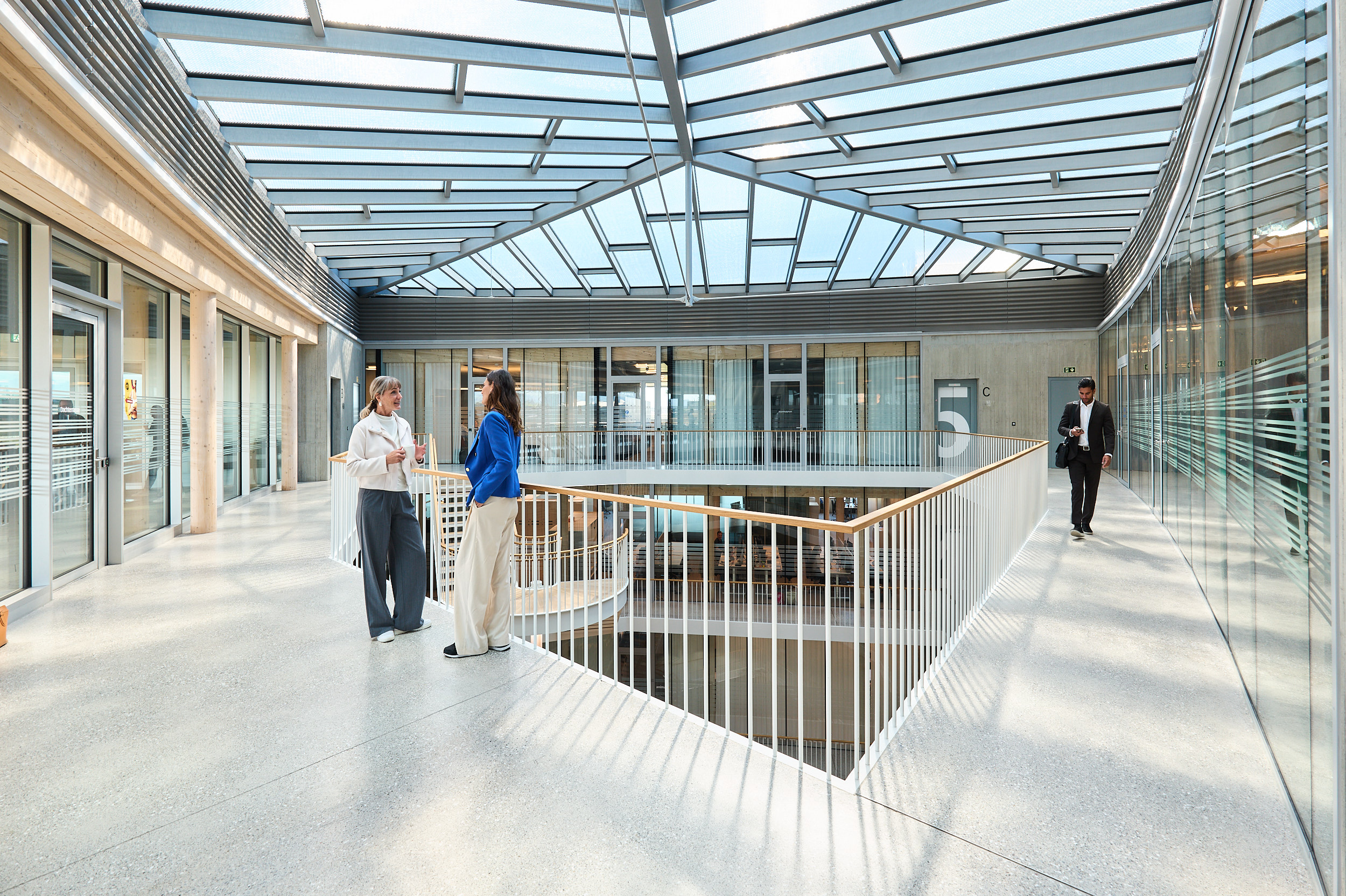
BERN 131 in Bern’s Wankdorf district demonstrates how this approach can be implemented in a specific project. Completed in 2025, this office and service centre was constructed using a hybrid method combining timber and concrete. Timber columns, joists and timber-concrete composite slabs form key parts of the load-bearing structure. The timber used comes from the canton of Bern, which has helped to reduce transport distances.
Existing resources were also utilised for the interior fit-out: various items of furniture and fittings from the former Jelmoli department store in Zurich were reused and integrated into the new building.
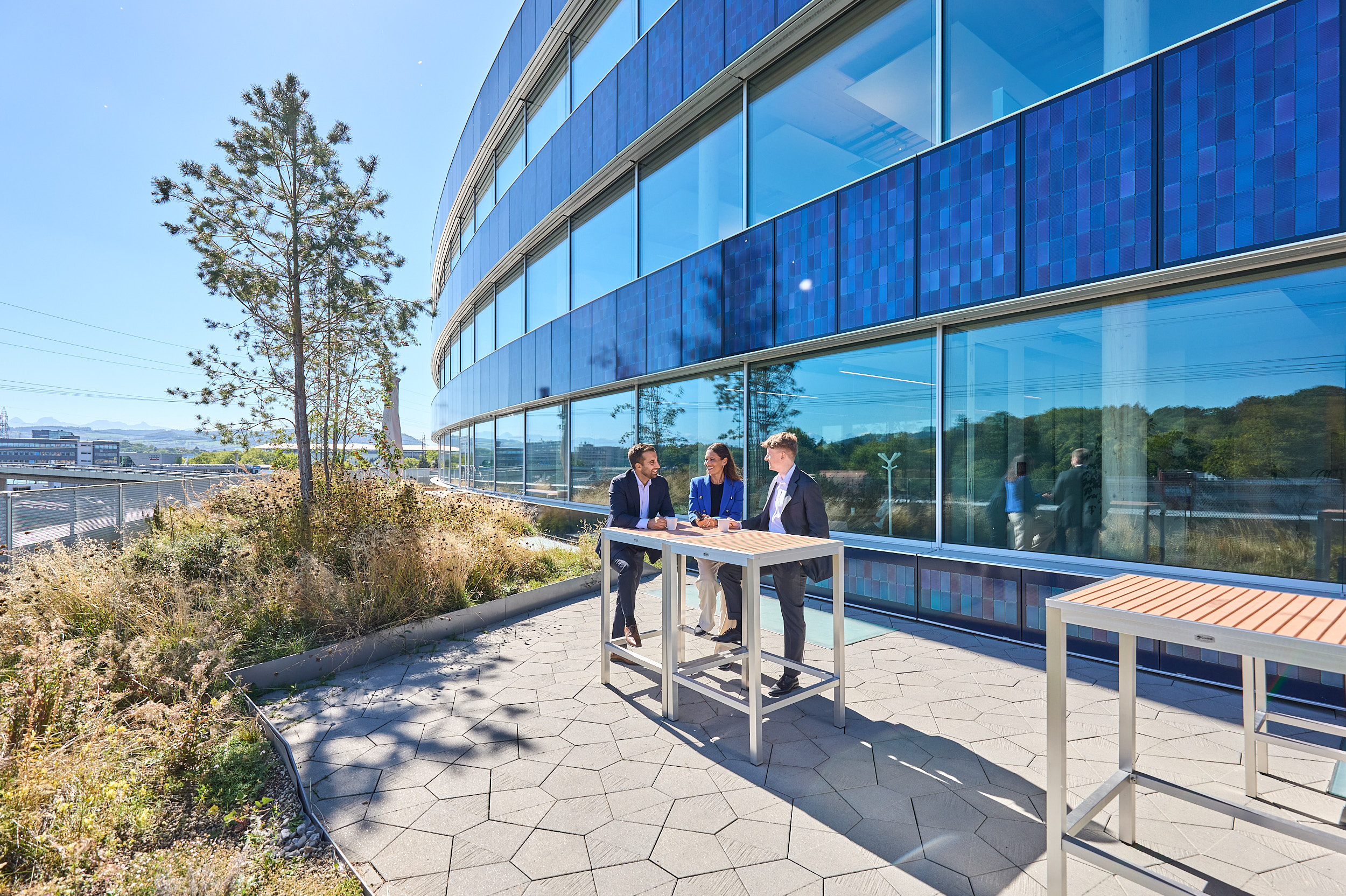
BERN 131 follows the principle of generating and using renewable energy directly on site. In addition to photovoltaic systems on the roof, the building features a fully integrated photovoltaic façade. The solar panels, in various shades of blue, fulfil two functions: they form part of the building envelope and contribute to local electricity generation. The building produces more energy than it requires for its operations.
Geothermal probes and heat pumps complement the energy concept and provide heating and cooling. This helps to reduce the reliance on fossil fuels.
How sustainable a property is does not depend solely on its energy consumption. It is also crucial whether it can be adapted to changing requirements. BERN 131 offers flexible office and service spaces that accommodate a variety of workplace concepts. This adaptability helps to extend the building’s service life and reduce the need for future structural alterations.
The outdoor spaces are also part of this concept: green roofs, terraces and surrounding areas not only promote biodiversity but also improve the microclimate in the immediate vicinity. At the same time, they enhance the quality of the environment for users. Added to this is the connection to public transport and the road network – a factor that also contributes to the long-term usability of a location.
From individual buildings to long-term transformation
BERN 131 is a prime example of a development that is increasingly occupying the entire sector. Sustainability is increasingly understood as the interplay between construction, energy supply, the circular economy, biodiversity and long-term usability.
For Swiss Prime Site, the project forms part of its CO₂ reduction strategy. However, the greatest challenges do not lie in individual new-build projects. The decisive factor will be how the existing property portfolio can be gradually decarbonised. This represents one of the key tasks facing the property sector in the coming years as it works towards achieving climate targets.